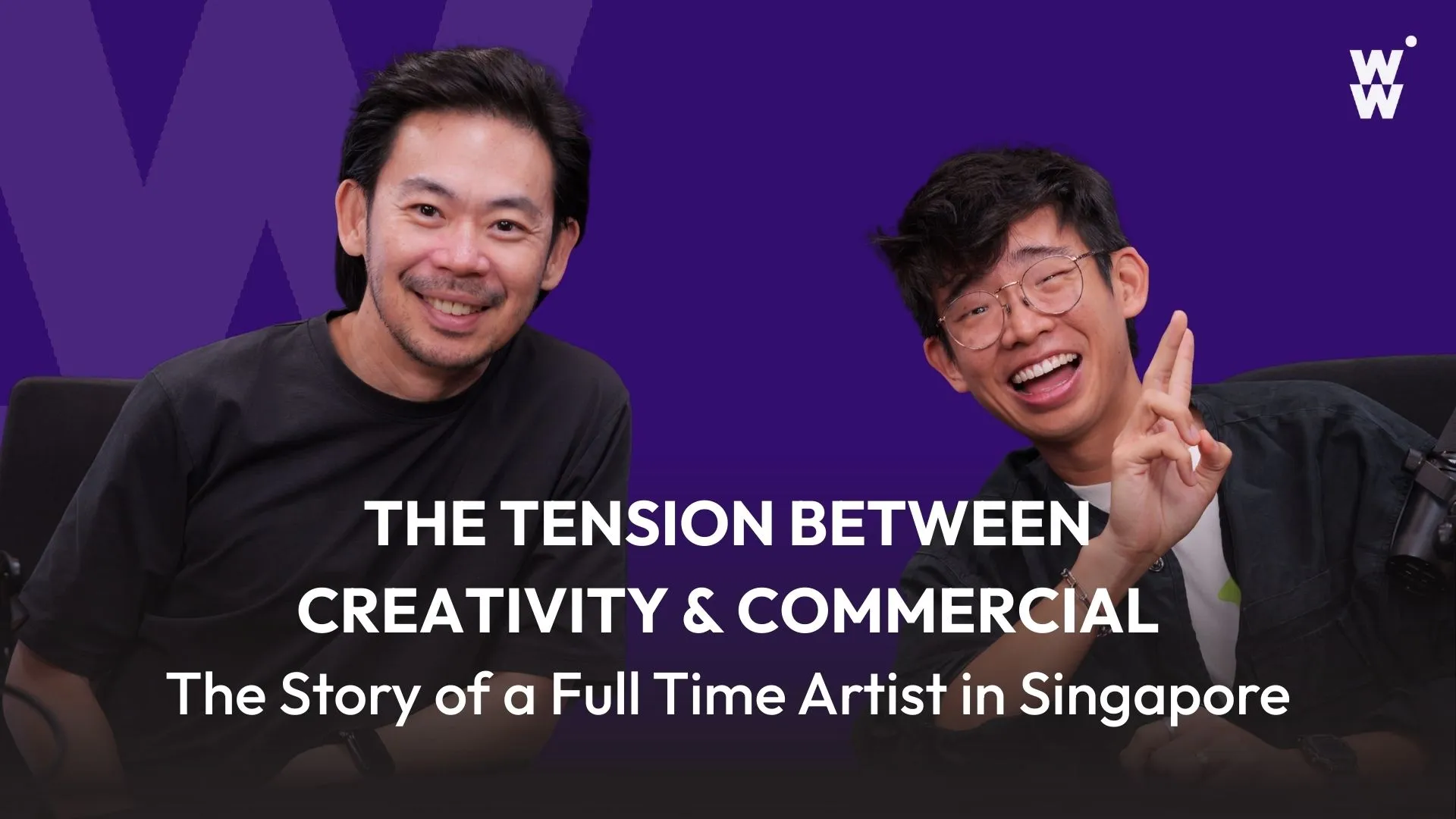
The Tension between Creativity and Commercial: The Story of a Full Time Artist in Singapore

What does it really mean to be a full-time artist in Singapore?
I first met Toby when I was looking for a Singaporean artist to design a mural for the office. And since then I've seen this young artist grow and blossom. I know he doesn't like to be 'praised' so I'll let him do the talking!
In this episode of the Wild & Wise Podcast, I sat down with Tan Xun Yi, Toby (tobyato) for an honest conversation about the quiet tension many creatives live with every day: the pull between staying true to your craft and making work commercially viable.
We talked about the realities behind the label “full-time artist", the discipline it takes, the trade-offs no one glamorises, and the internal negotiations between creativity, income, identity, and responsibility.
What stood out most was this: Being creative is not the same as being careless, and being commercial doesn’t automatically mean you’ve sold out.
This conversation isn’t just for artists. It’s for anyone navigating work that sits between passion and practicality, meaning and money, freedom and structure.
If you’ve ever asked yourself how to stay honest in your work while still making it sustainable, this episode will resonate.
Watch the full conversation here and if you like what you see, do subscribe.
Watch now on Youtube

Be Wild & Wise Today
Are you ready to unlock your strengths and achieve personal or professional growth? Whether you need help with personal branding, team alignment, or strengths-based coaching, Wild & Wise is here to guide you. Book your consultation and take the first step towards your transformation.
Subscribe to our newsletter
Lorem ipsum dolor sit amet, consectetur adipiscing elit. Suspendisse varius enim in eros elementum tristique.
Related posts
Explore more articles from Wild & Wise

Why Leaders Need Someone Who Will Challenge Them

The more senior you become, the more people agree with you, the less useful the conversations can get.
I just ended a meeting with another client and my phone rang.
In a calm steady voice, my client, a senior APAC leader in a global company, on the other end of the phone greeted me: "Hey Gerald, Happy New Year! Are you available tomorrow at 4pm?"
I replied in my usual casual chilled tone: "Happy New Year! What's up?"
"I need to bounce a few thoughts with you before I fly off to New York for a meeting with the global management team."
I replied: "I fly out tomorrow for another trip. How about today 4pm? I'll need to make a call to move an appointment around." (Thankfully I had a meeting with a friend who would understand!)
"Done. See you later."
This happened just last week. A senior APAC leader reached out before flying to New York for a critical meeting with their global leadership team.
We met at the client's office. We spent two hours in honest, robust conversation. We unpacked the proposal, the approach, the messaging, we spoke about the people in the room, the 'political' landscape and cultural dynamics.
Thankfully, I've ran a few leadership and Strengths workshops with the global team over the past 9 months and I knew the people on the leadership team and the overall business construct and progress.
I listened. We debated. We challenged each other to strengthen the thinking.
We challenged each other further. We disagreed with a smile.
Throughout the conversation, it was all positive energy.
By the end, the thinking was sharper, the choices clearer, and the intent more deliberate.
I walked away energised because I know how rare that space is.
At senior levels, there are very few places where you can be open and stretched. You’re expected to have answers, project certainty, and deliver, all while navigating increasing complexity.
This is why trusted advisors and executive leadership partners matter.
To help you see what you might be missing. To sharpen judgment before the moment matters.
Not to validate your thinking, but to challenge it.
Not to agree, but to help you see what you might be missing.
Not to rehearse slides, but to sharpen judgment before the moment matters.
I run leadership programs and workshops, and I love that work. But these one-to-one leadership conversations are just as meaningful to me.
Because this is where leadership really happens long before the meeting room.
If you’ve ever sat in that seat, you’ll know how valuable the right thinking partner truly is.
Every leader or manager needs a neutral, experienced, trusted thinking partner. That is what makes a difference every time you step into the boardroom.
If you don't have one, I would encourage you to find one.
No man and woman is an island.

Why Modern Leaders Need To Think Like Behaviourists, Technologists, and Business Owners

I didn't jump on the 2016 trend but it got me curious.
I scrolled through my photo gallery, reminded myself though I've aged through the years, how much I've grown. I also reminded me how much I miss my yellow lab 'Macy' who is no longer with us.
I then stumbled upon a picture I took, I'm guessing during my time as Global Digital Leader at GE (General Electric) probably at a planning session or a conference where I was speaking at.
My main message was this: "Every marketer needs to think and behave like a Behaviourist, a Technologist and a Business Owner" - Gerald Ang (2016)

These three pillars still stand today and perhaps even more so with AI and the way things are changing in organisations.
In the past, leadership success could be explained by expertise and experience. Today’s leaders operate in systems defined by speed, ambiguity, and constant reinvention.
In this environment, performance no longer depends on what leaders know, but on how well they understand human behaviour, technology, and economic reality working in one simultaneous cycle.
The Behaviourist
Leaders who think like behaviourists understand that incentives, norms, emotions, and identity drive outcomes more than plans. They understand people. Their strengths, the culture (“how we do things around here”), and individuals with their own aspirations and lives beyond work.
Culture is not values written on a wall or some 'corporate guidebook'. We’ve all seen leaders point to those values and still struggle to translate them into action.
Leaders who understand behaviour design environments where the right behaviours are clearly exemplified, consistently encouraged, and deliberately nurtured.
This is how culture translates into performance.
The Technologist
Leaders who think like technologists understand that technology is no longer a support function. It will eventually shape behaviour, how work gets done and how decisions are made.
Leaders don’t need to understand all the platforms and tools but what leaders need is the ability to understand the impact and provide solid judgment.
They understand how tools—especially AI—change speed, accountability, and decision quality. They are clear about what should be automated and where human thinking still matters. The leverage technology and redefine what the human tasks should look like.
Through technology, a savvy leader understands that higher value human tasks are what we should strive for as we 'out source' lower value human tasks which used to be done my humans are now done by machines.
Leaders need to remember that technology reshapes behaviour and power inside organisations.
The Business Owner
Leaders who think like business owners understand that headcount and resources are investments, not entitlements. In tighter environments, the real question is understanding “What can we deliver with what we already have?”
Entrepreneurs and business owners operate under constraint by default. They simplify problems, reuse capability creatively, and focus on outcomes rather than roles. Creating roles creates layers so this should critically assessed before it is even raised in the organisation. This forces clarity, sharper priorities, and faster decisions.
Leaders with this mindset stop treating headcount as the first solution.
They redesign work, question assumptions, and look for leverage before asking for more. This isn’t about doing more with less, it’s about doing the right work with discipline.
In the years ahead, leaders who can think like owners inside organisations will outperform those who simply ask for more resources.
With a business owner mindset, constraint becomes advantage.

10 Leadership Skills Your Team Can Actually See: A Guide to Authentic Leadership
Leadership isn't about having the biggest title or the corner office. It's about the daily actions your team notices and the trust you build over time. Great leaders leave clear signs that anyone can read, and these signs determine whether people want to follow them or just tolerate them.
1. True Leaders Serve First
Real leadership is about service. Your job as a leader is to support your team's success by providing clarity, coaching them through challenges, and helping solve problems. When you remove obstacles and share your experience, you're not just managing—you're serving.
2. Focus on People Before Tasks
Yes, projects need to get done. But your primary role as a leader is to grow people, not just check boxes on a to-do list. When you invest in developing your team members, you're building a stronger organisation for the long run. Tasks will always be there, but people need your attention to grow.
3. Hire Right Before You Train
Before spending thousands on training programmes, ask yourself: Did we hire someone who actually wants to lead? Do they have the emotional maturity to guide others? The best training in the world can't fix a poor hiring decision. Choose people with leadership potential from the start.
4. Care Like You Mean It
Your team knows when you're faking it. Genuine interest in their careers, goals, and even their lives outside work builds real trust. When people feel truly cared for, their confidence grows, their loyalty deepens, and their motivation soars.
5. Listen with Empathy
Don't just hear words but understand the context, feelings, and truth behind what your team is telling you. Empathetic listening creates psychological safety, which means people will share their real ideas, concerns, and creativity instead of just telling you what they think you want to hear.
6. Be Transparent (No Gatekeeping)
Share information openly with your team. Obviously, some things must stay confidential, but transparency about company direction, challenges, and decisions reduces stress and confusion. When people understand the bigger picture, they make better decisions and feel more connected to the mission.
7. Take the Blame, Share the Credit
When things go wrong, step up and own it completely. When things go right, shine the spotlight on your team. This isn't just good manners, it's smart leadership. People will walk through walls for leaders who protect them when times are tough and celebrate them when times are good.
8. Create Psychological Safety
Can your team speak the truth without fear? Can they ask hard questions? Can they disagree with you without worrying about consequences? When people feel safe, they innovate, take smart risks, and bring their full creativity to work. Fear kills innovation. Safety fuels it.
9. Use People's Strengths
Everyone on your team is good at something. Your job is to figure out what that is and give them opportunities to use those strengths. “Don't force a bird to swim and a fish to fly.” When people work in their zone of genius, everyone wins.
10. Spend Quality Time with Your Team
Leadership takes time, and there's no shortcut. Spend real, focused time learning what energises each person, what challenges they face, and what they value most.
These 10 skills aren't theory
They're the practical, daily behaviours that separate good leaders from great ones. They're about mindset, strategy, and emotional intelligence combined.
The good news? These skills can be learned and developed with the right approach. Whether you're already in a leadership role or preparing for one, building these habits starts with understanding your natural strengths and how to leverage them effectively. When leaders work from their strengths rather than against them, development feels less like fixing weaknesses and more like unleashing potential to thrive in any situation.
Ready to lead with authenticity? The leaders your team actually wants to follow don't try to be someone they're not—they discover what makes them uniquely effective and build from there. Every leader has a different combination of natural talents. The key is knowing yours and using them intentionally.
Take our leadership quiz to discover your unique style: https://www.wildnwise.co/leadership-strengths-quiz