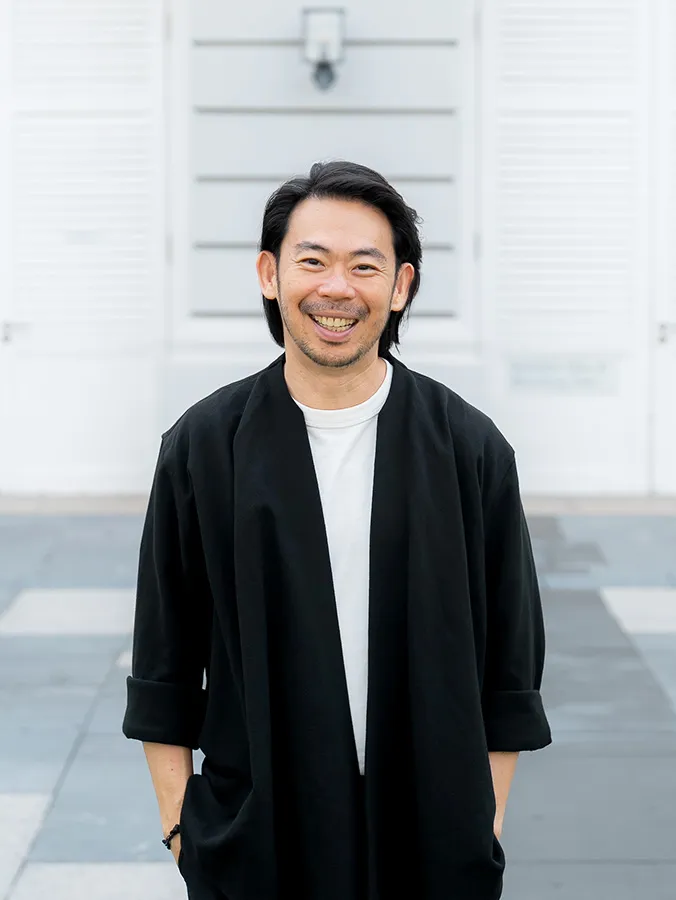
Who are you without your "day job." Who are you without your "career." Who are you without a "job title." How would you describe yourself, what you do and how you approach your life and work? If someone respects you because of your title and not YOU as a human being, what does that say?
These concepts are about identities. We go through life trying to figure out who we are. We reference people we look up to. We look up to others who have a swagger or style. We search for our tribe. And with all these behaviours, it still doesn't speak to who we really are. Well, at least till we really start to reflect, to be vulnerable and curious and to start the journey on discovering our anchors and how we think, feel, behave.
It's the same at work. Do you tie your identity so closely to your job that without it, you feel lost? And now there's a sharper version of that question. AI is already doing pieces of what used to fill a job scope, so the old question of who you are without the title has a new edge to it now that the title itself is starting to dissolve. YOU remain consistent regardless of the job title and scope. It's how YOU approach the job and the challenges that come with it.
I do want to make this clear that there's a distinction between competency and knowing who you are. I could call myself a DJ and have a cool collection of music. But I can't properly beat-match two songs and play a solid two hour set to a packed floor. It's just a title I've given myself. I'm still a pretty crap DJ. If we link this to work, competency always comes first so we can really excel in what we do. But how we do it, that's where it gets interesting.
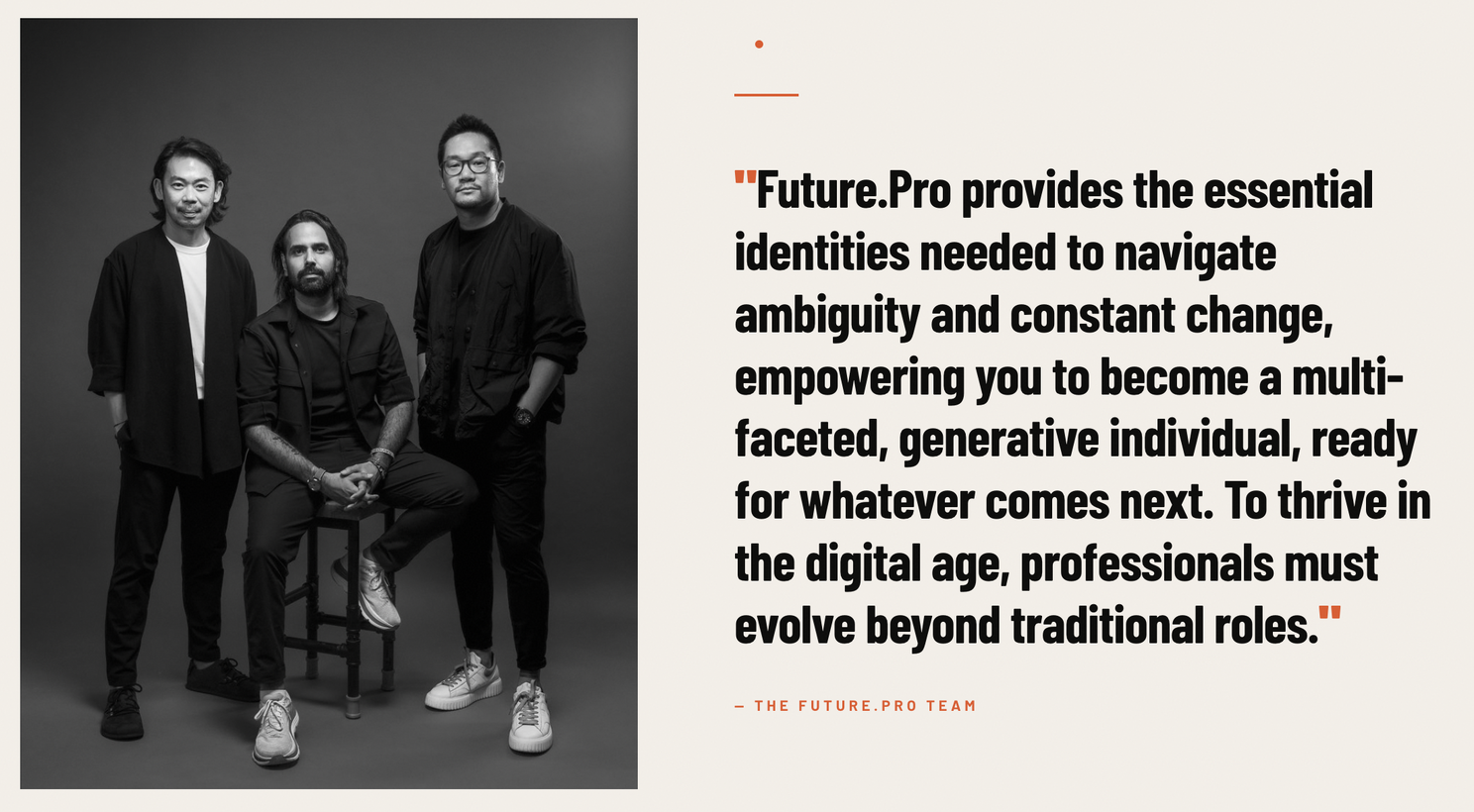
Together with the co-founders of Future.Pro (Website: Future.Pro), we've been building a simple way to think about this.
The Future Professional: Four Identities, One Practice
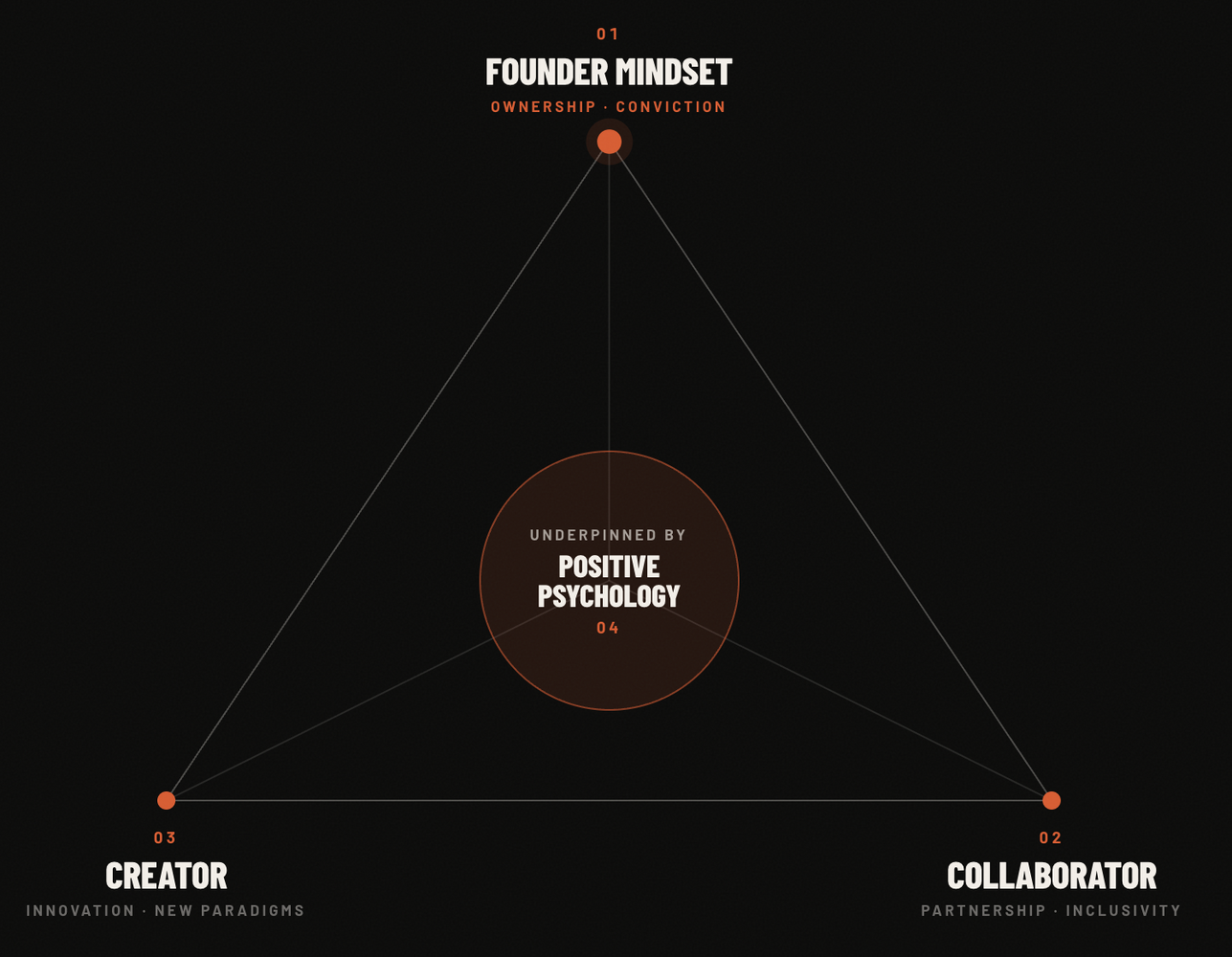
A Founder Mindset. A Creator. A Collaborator. Strengths and positive psychology sit in the middle of all three, the anchor that decides whether people force these identities or actually live them.
A Founder Mindset
Founder Mindset is grounded in extreme ownership, the language of conviction, purpose and obsession.
I've always taken on my corporate roles as if I ran them like my own business. It's about who owns the outcome when things get ambiguous. We have to play to win and be obsessed, in a positive way, on achieving the best with what we first have. If we ask for more, it's got to be innovative and exponential. 1 x 1 = 3.
If we embrace our identity as a Founder, our lens on the work changes. One real example was when I was tasked with organising a concert during my time at BlackBerry. I was the Regional Digital Marketing Lead turned event and concert organiser. It was one of the best experiences of my career, only possible thanks to the awesome partners in Jakarta. Some of the articles and pictures still live online.
With AI now in every conversation, it means even more with a founder mindset.
The World Economic Forum's Future of Jobs Report 2025 found analytical thinking is the single most sought-after skill among employers, for the third year running. Korn Ferry's 2026 survey of over 1,600 talent leaders found 73% rank critical thinking as their top hiring priority, with AI skills ranking fifth.
AI fluency means owning the outcome, not just operating the tool.
A Creator
Creator is what brings the new and unseen to life, the instinct that keeps a professional relevant when the tools change faster than the job description.
Don't mistake Creator as being only Creative. There's this expression, we can all apply creative approaches even to the most boring problem. Creative thinking doesn't sit only with the marketing department. I spent a long stretch of my career with "marketing" in the job title, which meant everyone assumed creativity was my department's job and execution was theirs.
A Singaporean jazz musician once shared with me: "Creativity energy can be applied to anything we work on, it doesn't exclusively need to be only for anything 'creative' like music or art. It can be applied to solving business problems or even a strategy."
Some of the best creative work I've seen come out of a business had nothing to do with a campaign, it was someone in operations who got tired of a broken process and quietly rebuilt it because they couldn't stand watching it stay broken.
The World Economic Forum's Future of Jobs Report 2025 puts AI and big data at the top of the fastest growing skills for the next five years, but creative thinking and adaptability are rising almost as fast. 170 million new jobs will be created this decade, against 92 million displaced. The line between those two numbers gets drawn by whoever can create, not just execute.
A Collaborator
Who's the person in your meetings who says the least but somehow makes everyone else think better.
Collaborator is the identity built on partnership, on the collective wisdom no individual holds alone, and it's the one most leaders underestimate. I spent years assuming leadership meant walking into the room already holding the answer. It took a long stretch of time in multinational organisations and coaching senior leaders to see that the strongest ones walk in without one, and build it together with whoever's sitting across from them.
Gallup's 2026 report found only 14% of Singapore's workforce is engaged at work, a number that traces back to leadership more than to technology. The same report found that employees whose managers actively champion AI use are almost nine times more likely to say the technology has actually transformed their work. Access to the tool means almost nothing without someone leading its adoption.
Strengths & Positive Psychology
What happens when you take away the job title, the KPIs, the org chart, and just ask someone what they're actually good at.
Strengths and positive psychology are the ground the other three identities stand on. Founder mindset, creator, and collaborator all break down the same way when a person operates from what they lack instead of what they actually have. In every CliftonStrengths session I run, there's a moment where someone realises they've spent years trying to fix what they're bad at, instead of building on what they were actually built for.
AI adoption, critical thinking, creative skill demand, the engagement collapse we just looked at, all of it still runs through a person, and a person working from their strengths sustains the other three identities. A person working from their gaps burns out trying to force them.
None of this is really about four skills to learn. It's four ways of being that were probably already in you, waiting for someone to name them.
This is the exact thinking behind Future.Pro (Website: Future.Pro), for leaders and teams asking what their AI strategy actually means for their people, without answering with a tool list.
Reach out if you are keen to learn more about Future.Pro. Check out our new website www.futurepro.io. Email: ask@futurepro.io
As work moves faster than learning can keep up, performance suffers. We craft bespoke, design‑led learning experiences that equip today's professionals with tomorrow's critical skills. Prepare your people for what's next — start building future‑ready talent today.
About the Author